Turn Claude into a business consultant in an afternoon
Connect Claude to HubSpot and Slack, then ask what's actually working. Fifteen minutes to set up, and one section on exactly where it will lie to you.
Last checked September 7, 2026. Connectors, pricing and prebuilt workflows in this space change monthly, so confirm the current state before you act on any of it.
A consultant's first two weeks are almost entirely data gathering. They read the CRM, sit in on calls, scroll back through Slack, interview half the team, and then come back with patterns you could have found yourself if you'd had a spare fortnight. Two of those four jobs are now a connector and a prompt.
I did this at a company I worked at previously. I connected Claude to Slack and HubSpot, then asked it a question I'd been arguing about with the marketing team for months: which lead sources actually turn into enterprise deals, as opposed to which ones produce the most leads. Those turned out to be different lists. The sources everyone was proud of were filling the top of the funnel with small accounts, while the enterprise deals traced back to a couple of channels nobody was investing in because the raw volume looked unimpressive. We changed what we wrote and where we put it, and enterprise leads went up.
The useful part wasn't the answer, which in hindsight looks obvious. It was that the question took eleven minutes to answer instead of sitting in the "we should look into that" pile for another quarter.
HubSpot shipped the first CRM connector in July 2025
HubSpot shipped the first CRM connector for Claude on 29 July 2025, built on MCP, which lets you ask questions of your CRM data in plain language and get charts and actions back inside HubSpot. Karen Ng, HubSpot's EVP of product, put it as available to all HubSpot customers across all tiers, provided you have a paid Claude subscription. Claude now connects to more than 50 tools, Slack, Gmail, Drive, Notion and HubSpot among them.
Anthropic followed with Claude for Small Business in 2026, which ships around 15 prebuilt workflows spanning QuickBooks, PayPal, HubSpot and Canva. One of them watches for a sales lull, reads your HubSpot campaign performance, drafts a promo and generates the Canva assets to run it, which is a decent illustration of where this is heading: less "ask the chatbot a question", more "the analysis runs and tells you something".
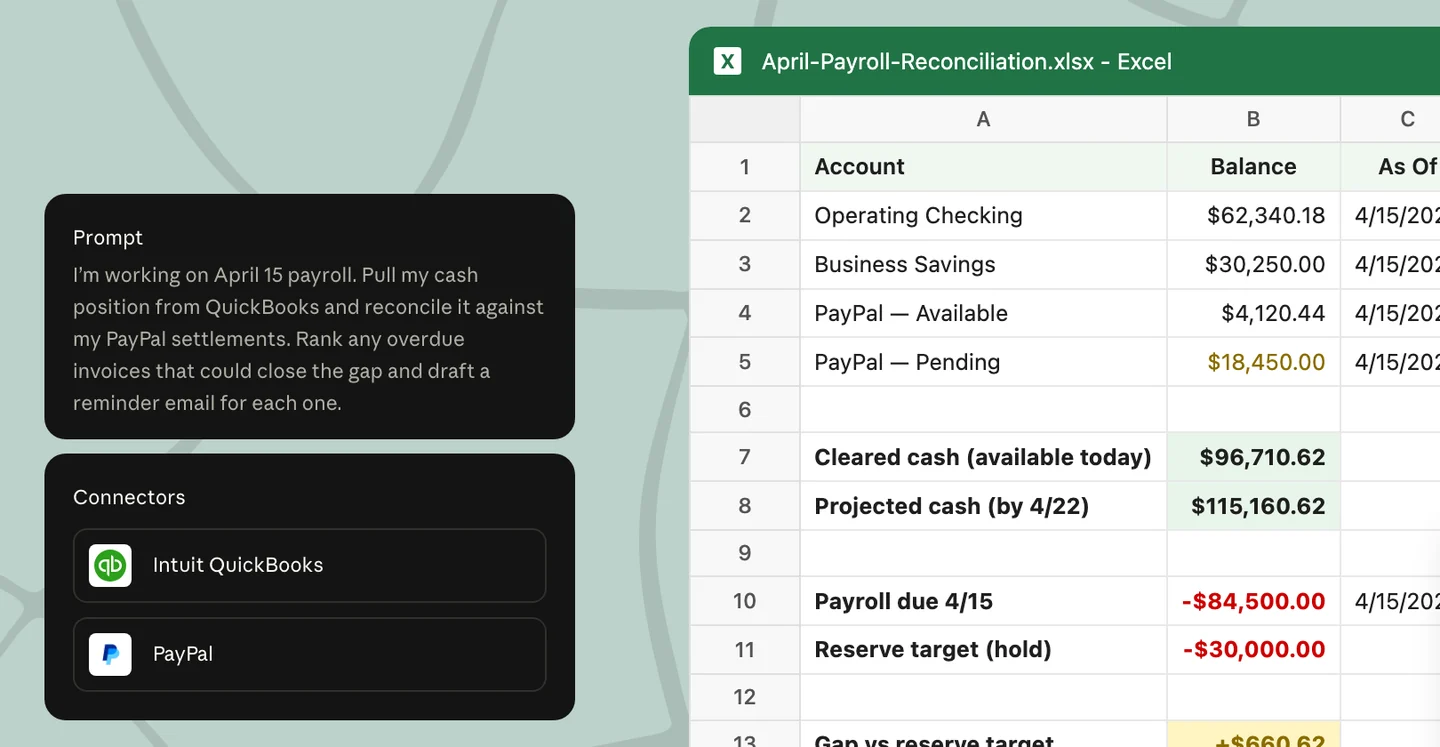
The connector is the difference between a model that reasons about your business in the abstract and one that reads the records.
Fifteen minutes to connect the three that matter
You only do this once.
- In Claude, open Settings, then Connectors, and browse the directory of available tools.
- Connect HubSpot first. You'll be sent through HubSpot's own OAuth screen to approve access, and the scopes you grant are the scopes Claude gets, so read them rather than clicking through.
- Connect Slack the same way. If your workspace requires admin approval for new apps, this is the step that takes a day rather than a minute, so start it early.
- Connect Gmail or Drive if the answers you want live in email threads and documents rather than in the CRM.
- Start a new conversation and ask it something you already know the answer to. You are checking that it is reading your data rather than guessing, and a question you can grade is the cheapest way to find out.
That last step matters more than it sounds. Everything below assumes Claude is reading your records, and the failure mode worth guarding against is a confident answer assembled out of nothing.
The seven questions worth asking on day one
These are copy-pasteable. Run them in order, in one conversation, so each answer has the previous context.
- Which lead sources produce closed-won deals, ranked by revenue rather than by volume?
- What objections appear in the deals we lost that do not appear in the deals we won?
- What are customers asking in Slack that is not answered anywhere on our website?
- Which current customers show the behaviour patterns that preceded our last three churns?
- Where is the longest gap between two stages in our pipeline, measured in days?
- What did we promise in sales calls that we are not delivering in onboarding?
- If I could only fix one thing in this pipeline next quarter, what does the data say it should be?
Question one is the one that changed my mind about all of this, and question seven is the one that ties back to where the constraint actually is.
The prompt that replaces a consultant's opening report
The seven questions are a warm-up. This one is longer, and it works best once the connectors have been live long enough to cover a full sales cycle.
You are acting as an operations consultant hired to find the single biggest constraint on revenue in this business. You have access to our HubSpot, Slack and email through connectors. Use them; do not answer from general knowledge.
Context: we are a [size] business selling [what] to [who], at an average deal size of roughly [amount], with [number] people involved in sales delivery. Our stated goal for the next two quarters is [goal].
Work through this in order:
- Map our funnel stage by stage, using real counts from HubSpot, and show the conversion rate and the median time in days between each pair of stages.
- Identify the stage where the most value leaks out, and separately the stage where work waits longest. Say which of the two you believe is the real constraint, and explain why.
- Pull the language customers actually use about their problem, from call notes, Slack and email, and quote it verbatim rather than paraphrasing.
- List the three most common objections in lost deals, with the count of deals each one appears in.
- Tell me what you would fix first if you were accountable for the revenue number, what it would plausibly be worth per month, and what evidence in our data supports that estimate.
For every quantitative claim, cite the specific records, deal IDs or messages you drew it from, and state the query or filter you used. Where our data cannot support a claim, say so explicitly rather than estimating.
Fill in the bracketed context properly. The difference between a generic answer and a useful one is almost entirely in how specifically you describe the business before you ask the question.
Where it will lie to you
This section is not optional. Claude, like every model, will produce confident-looking numbers when it is reasoning rather than reading. Keyword search volumes are the classic example: ask for them without a data source attached and you will get a plausible, precise, entirely invented table.
Three rules that make the output trustworthy. Make it cite the record behind every number, so you can click through to the deal. Ask it what query or filter it ran, because a vague answer there means it didn't run one. Spot-check three figures against the source system yourself before you act on any of it.
There's a structural version of this problem too. MIT's Project NANDA work found that connecting AI to raw data without a governed layer of business meaning is itself a documented failure mode: if "closed-won" means three different things across three pipelines, the model will average them into a number that describes nothing real. Fixing your stage definitions before you run the diagnostic is unglamorous and it is usually the most valuable hour in the whole exercise.
What to actually do with the output
The report is not the deliverable. One decision is.
Take the answer to question seven, or step five of the long prompt, and treat it as a hypothesis about your constraint. Then check it against the one-page test: is it a queue where work piles up, and what does the number become if you clear it? If the answer holds, build one thing there. If it doesn't, you've spent an afternoon and learned something about your own pipeline, which is a considerably better outcome than the average strategy offsite.