Your last 100 sales calls contain your next quarter's content plan
The objections that kill deals are stated out loud, repeatedly, by the people who don't buy. Here's how to mine that free research.
A team running 40 sales calls a month, at half an hour a call, records about 240 hours of customers describing their own problems over the course of a year. Almost nobody listens back to any of it. The recordings pile up in Zoom or Fathom or Gong, get referenced twice during a deal review, and then sit there as the most expensive unread research any small company owns.
The objections that kill your deals are stated out loud, repeatedly, by the people who then don't buy. That is free market research being thrown away because reviewing it used to cost more hours than anyone had.
The proof that reviewing calls moves numbers
Gong Labs published a study on 15 February 2024, "We measured the ROI of AI in sales", covering more than a million sales opportunities across 1,418 sales organisations. Teams using its Smart Trackers for deal execution saw 35% higher win rates. Teams using Ask Anything, the conversational layer over their call data, saw 26% higher win rates.
Those numbers describe teams paying for a full conversation intelligence platform, which is worth saying plainly. The point isn't that you should buy Gong. It's that systematically reading your own calls is worth something like a third of your win rate, and the reading is now the cheap part.
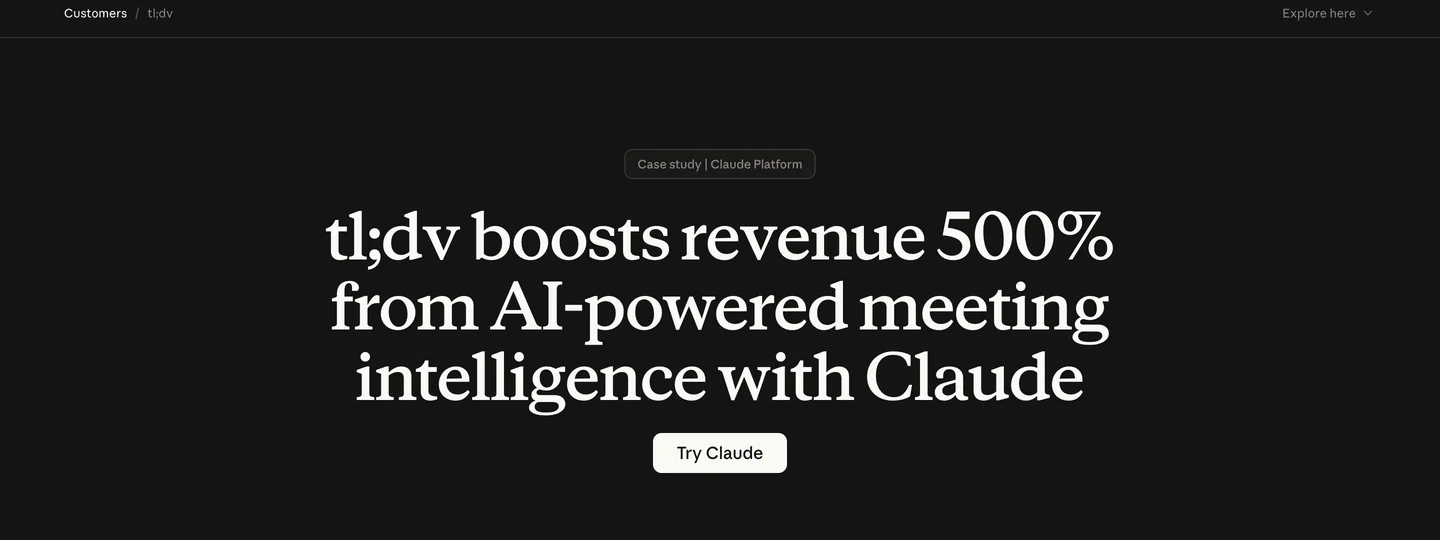
On the vendor side of the ledger, tl;dv rebuilt its product on Claude and reports 300% growth in sign-ups, a 500% revenue increase, monthly churn down 20 to 30%, and summaries generating 50% faster. Its CEO Raphael Allstadt frames the shift as going from a recap tool to an intelligence engine. Those are the company's own published figures from a customer story, so read them as what's possible for a company that gets this right rather than as an expected outcome.
The version you can run without buying anything
You need transcripts, a folder, and an hour.
- Export transcripts from wherever your calls already record. Most tools will bulk-export as text or VTT.
- Drop them in a folder, named so the file tells you the outcome:
2026-06-11-acme-lost.txtbeatsmeeting-recording-4471.txt. - Separate won from lost. Almost every useful question is a comparison between the two piles, and sorting them once makes every later prompt sharper.
- Work in batches of ten to twenty calls rather than feeding in a year at once. The answers stay specific, and you can check them.
If your calls already live somewhere Claude can reach through a connector, you can skip the exporting entirely and point it at the source.
Three prompts that do the work
Below are transcripts from [number] sales calls. The filenames indicate whether each deal was won or lost.
Extract every objection, hesitation or stated concern raised by the prospect. Group them into themes, and for each theme give me: the number of calls it appears in, the split between won and lost deals, two verbatim quotes, and where in the conversation it typically surfaces.
Rank the themes by how often they appear in lost deals specifically. Quote exactly; do not paraphrase or clean up how people spoke. If a theme appears fewer than three times, list it separately as a long tail rather than mixing it in.
Using the same transcripts, compare the calls we won against the calls we lost.
Tell me what is present in won calls and absent in lost ones, covering: which questions the rep asked, what the prospect said about their timeline and budget, how price came up and who raised it first, and how the next step was agreed at the end of the call.
Then tell me the single behaviour that most reliably separates the two groups, with the evidence you based that on and the number of calls supporting it. Where the sample is too small to be confident, say so.
From the same transcripts, pull the exact language customers use to describe the problem we solve, before anyone on our side has framed it for them.
Give me: the phrases they use for the problem itself, the words they use for the cost of not fixing it, the metaphors and comparisons that recur, and the terms they use that we never use in our own marketing.
Quote verbatim, with the call each phrase came from. Flag any phrase that shows up in three or more separate calls, since those are the ones worth putting on a page.
The loop only closes at the last step. Extracting objections is research; publishing the answer is what moves the win rate.
Closing the loop into marketing
This is the part most articles about call analysis leave out, and it's where the return actually comes from.
The objections you pull out of prompt one are a content plan. Each recurring theme is a page, a case study or an FAQ answer whose job is to handle that objection before a call ever happens, so your rep spends their forty minutes on the deal rather than on the same rebuttal for the ninth time.
The phrases from prompt three are your headlines. Direct-response copywriters have been making this argument for fifty years: specific language out-pulls vague language, and the words your customers already use out-pull the words your marketing team invented in a workshop. You now have both, sourced from people who were deciding whether to give you money at the time.
Win rate by objection type, ninety days out
Measure it before and after you publish the content that handles each objection, and give it a ninety-day window, because a page that pre-handles an objection has to be found before it can work.
If that feels slow, track the leading indicator instead: how often the objection still comes up on calls. When your reps stop hearing it, the page is doing its job, and that shows up weeks before it shows up in the win rate.